Lot’s of people sense that private equity is everywhere in our economy. But they don’t know exactly how.
We just released a new Roosevelt Institute working paper that fills this gap: “The New Private Equity: “The New Private Equity: Corporate Raider, Main Street Invader, Monopoly Builder, Shadow Owner.” Albina Gibadullina, Adam Goldstein, and Marie-Lou Laprise are also coauthors.
I’ll be presenting the paper next Thursday October 29 at 4 pm at Berkeley. If you’re in the area, register here.
We show that PE grew to own between 9% and 15% of the economy in 2020, higher today. But we show PE’s impact extends even further because it increasingly buys out Main Street businesses, merges them, and then sells them to other monopoly builders, both public and private. They do so as shadow owners with longer hold times and more secondary sales than were common with the public corporation buyouts and slicing and dicing restructurings of old.
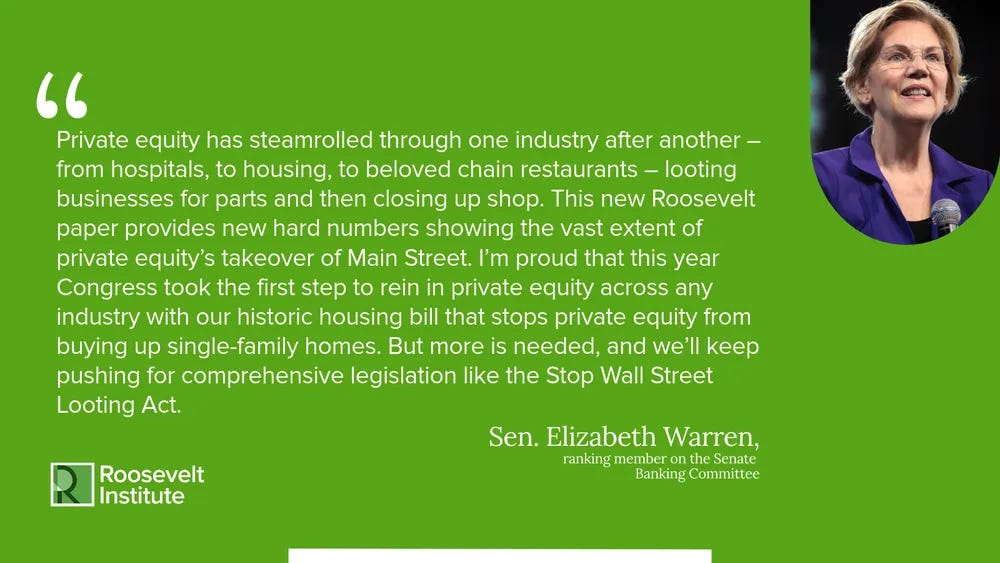
Here’s what Senator Elizabeth Warren says about the paper:
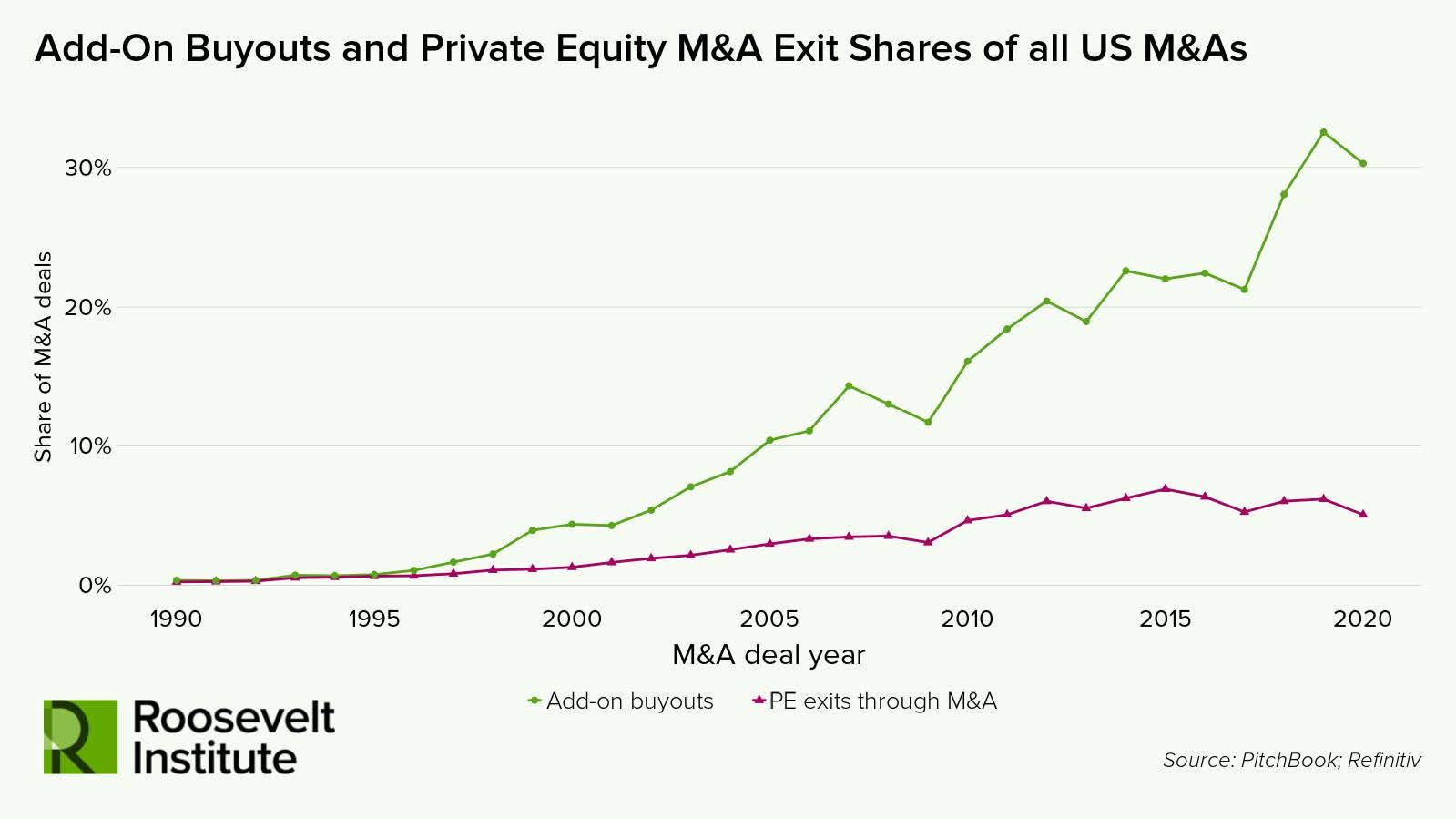
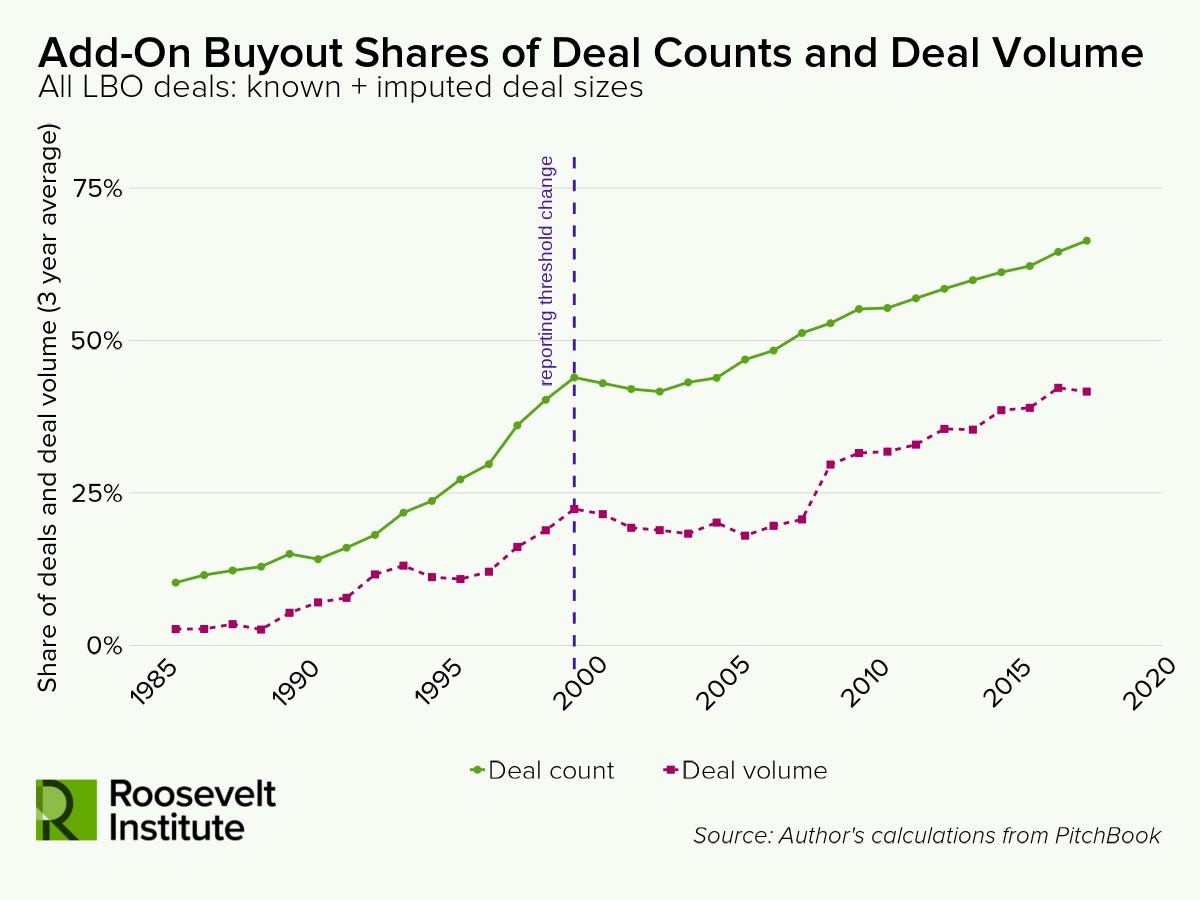
My favorite plot from the paper shows how “add-on” buyouts for acquiring and merging competitors have grown to over 60% of private equity buyout transactions and 40% of buyout volume. We used multiple imputation techniques to measure this growth that had been hidden since the weakening of FTC merger reporting requirements in 2000:
Others have told parts of this story. But we put it all together with better data and estimation techniques, analyzing all 56,974 buyouts in the Pitchbook database from 1985 through 2019. Among other things, this also reveals:
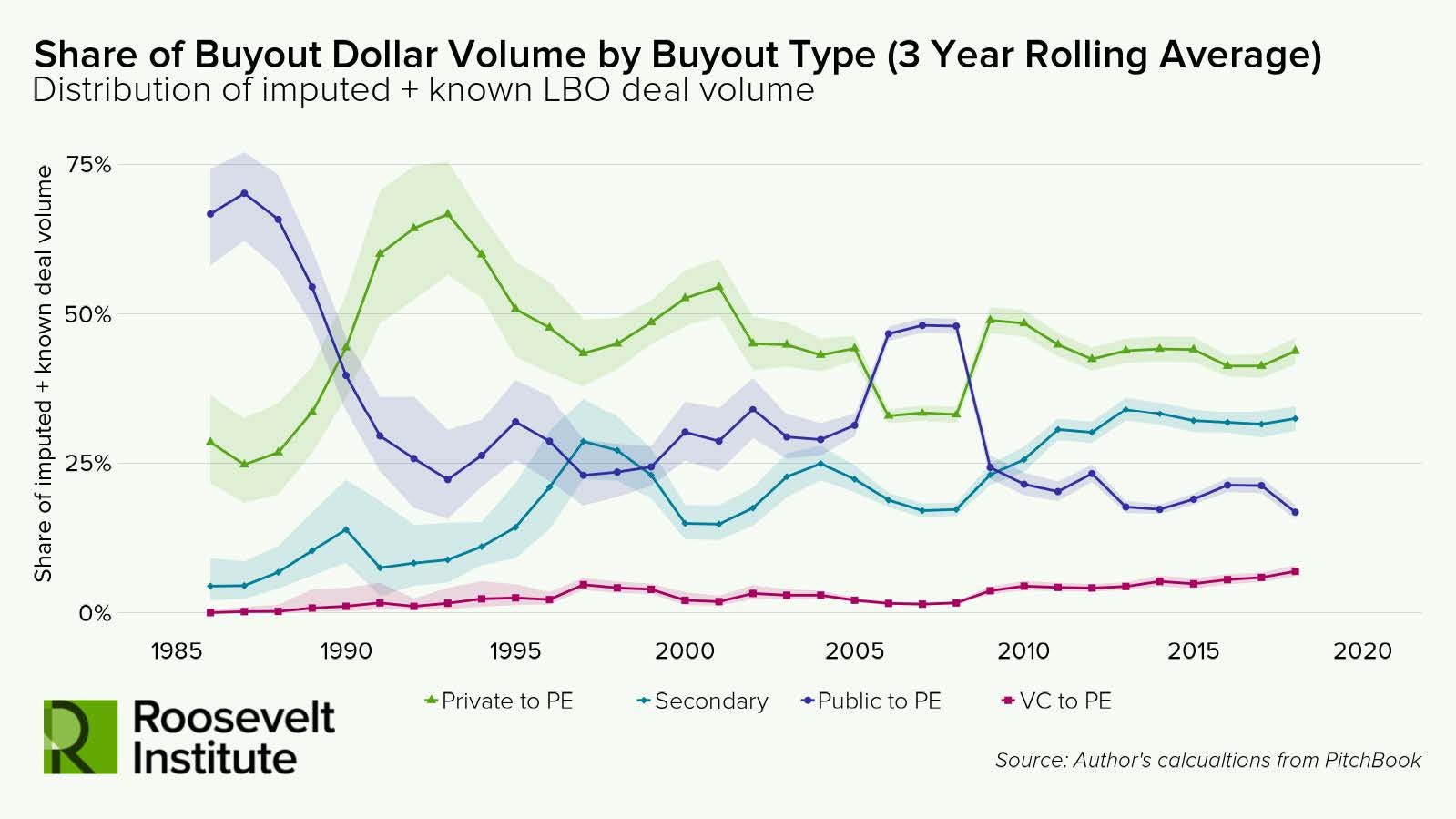
Buyouts of public firms fell to as little as 20% of deal volume in 2019.
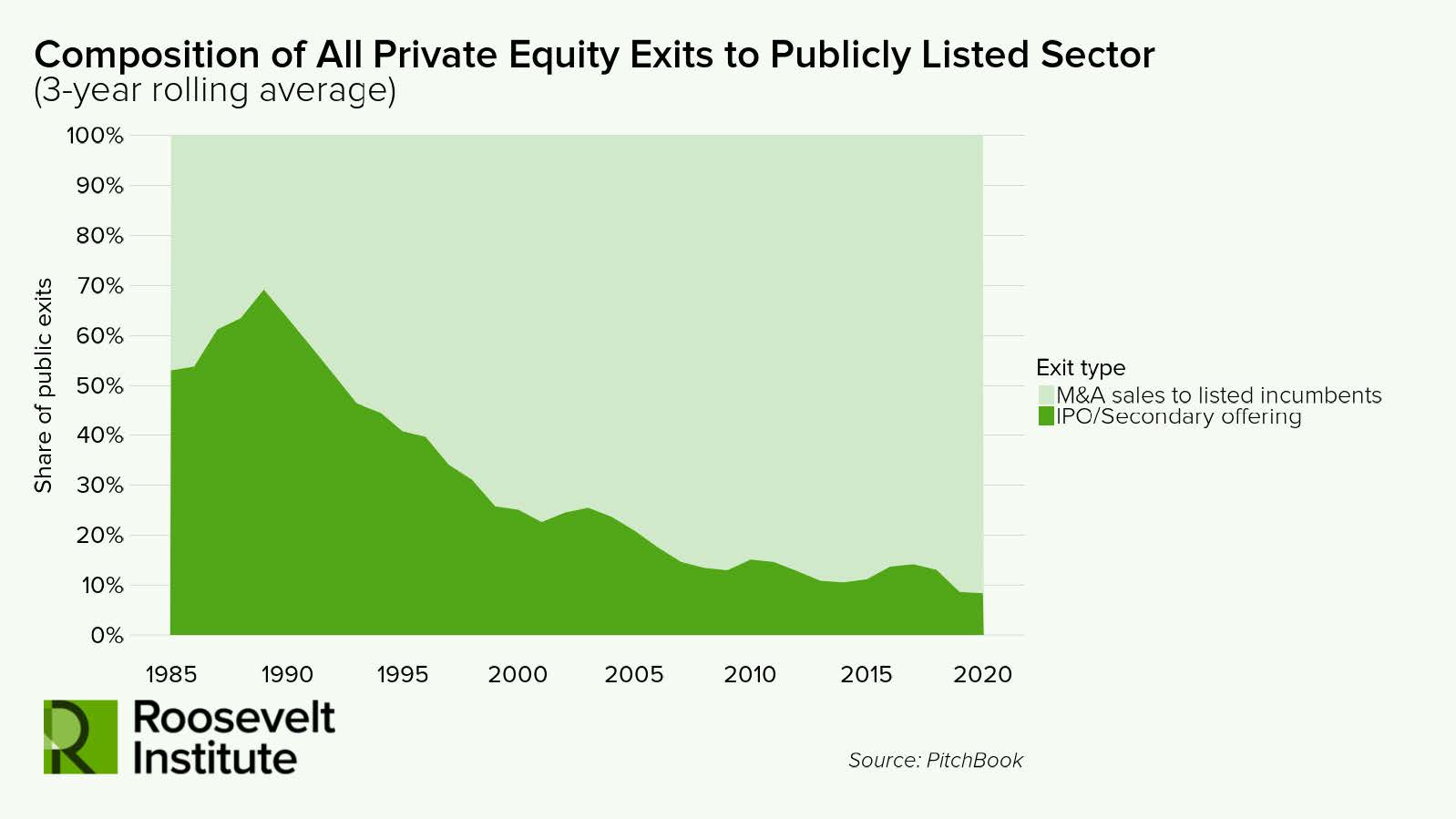
IPOs fell to less than 2% of private equity exits by 2020. But M&A sales to other companies continue to make up 40% of exits -- including around 15% of exits which are M&A sales to public companies.
Private equity add-on deals grew to make up more than 30% of all M&A deals in the economy, up from below 5% in 2000.
With the fall in IPOs and persistence of M&A sales to public companies, M&As are the main way that private equity builds public companies -- adding to conglomerates rather than growing competitors.
As a result, we write in the paper:
Private equity’s rise may augur a new “dark mode” for shareholder value capitalism that complements the hegemony of the largest public corporations.
Roosevelt is working on policy solutions for these opaque and monopoly building activities by private equity in the US. And Senator Elizabeth Warren, Ranking Member of the Senate Banking Committee, had this to say about our findings:
Private equity has steamrolled through one industry after another – from hospitals, to housing, to beloved chain restaurants – looting businesses for parts and then closing up shop,” said . “This new Roosevelt paper provides new hard numbers showing the vast extent of private equity’s takeover of Main Street. I’m proud that this year Congress took the first step to rein in private equity across any industry with our historic housing bill that stops private equity from buying up single-family homes. But more is needed, and we’ll keep pushing for comprehensive legislation like the Stop Wall Street Looting Act.
For the TLDR version of our paper, below are some of the key figures that tell more of the story.