


After trying other alternatives on for size, I’m going ahead and renaming this newsletter Axis of Oligarchy.
This reflects my research’s increasing focus on how Wall Street and Big Tech oligarchs have gained so much political and economic power in America and globally. And it will facilitate workshopping ideas for a book through this newsletter. I’ll still be thinking and writing about universities, especially with regard to their relationships to American oligarchs.
Following up on a related report, a Times investigation recently exposed that billionaire spending on elections has grown from less than 1% of all spending before Citizens United to 19% in the 2024 elections. This is what oligarchy looks like.
Back in November, I gave a talk at UMASS about the role of Wall Street and Big Tech in this transformation of political spending. This is my first effort to appraise how these two industry and social groupings of oligarchs may be different than the Koch brothers or the oil barons that preceded them.
I particularly asked: to what extent did both big tech and Wall Street turn to Trump in the 2024 election and why? Second, did increasing oligarchy in big tech and Wall Street lead supportive factions to more proactively support Trump’s authoritarian turn in 2024, rather than just supporting it, tacitly or actively, in response to Trump’s victory and adoption of authoritarian strategies. What follows is my exploration of these questions from the talk.

Some of my intellectual motivation is that Levitsky and Ziblatt have suggested that economic elites can be enablers of democratic backsliding. They suggest that this is against their own interest, because autocrats roll back the rule of law. Erosion of rule of law introduces uncertainty that can be bad for business, and allows autocrats to weaponize the law to subordinate even economic oligarchs to their own power and whims. We’ve seen evidence of this in Trump’s tariff weaponization and attacks on big law.
But I don’t think Levitsky and those engaging his work have given much attention to which elites might be most likely to become enablers and why. And investigative reporting has indicated that some economic elites encouraged or even helped develop elements of Trump’s authoritarian push in the lead up to 2024 via Project 2025 and less public initiatives. This raises questions about whether some elites may encourage, rather than just enable, democratic backsliding.
Some potential answers to these questions that I’ll sketch today: private equity, venture capital, and big tech swung to Trump in 2024 more than other wealthy elites. They did so because new oligarchs from these industries perceived threats to their wealth and power from Democratic policy makers, particularly around anti-trust.
The first empirical observation that led me towards this line of thinking is that there have been sectoral shifts in the composition of the US billionaire class towards Wall Street and Big Tech over the last 40 years. And these billionaires are wealthier than the billionaires of 40 years ago. This may not be that surprising, but I haven’t seen it well measured. And it raises the question of whether the wealth and economic projects of these new billionaire factions may be among the structural antecedents to Trump’s authoritarian turn.
I noticed this in my paper Elite Embeddedness with Albina Gibadullina. The paper is about the unusually high representation of private equity and hedge fund managers on elite university boards. Part of this is because private equity and hedge fund managers grew to be one of the largest groups of billionaires over the last 40 years. This figure recasts and supplements data from the paper to plot the change in the % of billionaires by sector:
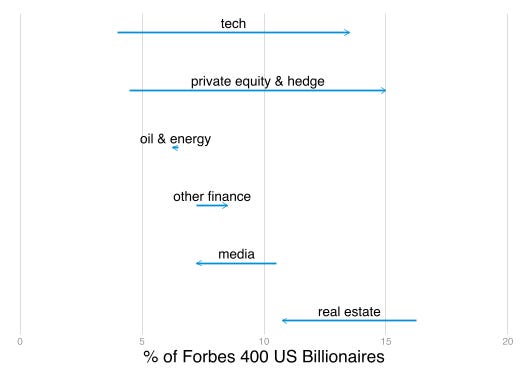
If you view elite university boards as a field of power that connects economic and political elites, the other thing we found in our paper is that financiers join elite university boards more than even other billionaires. Building on the work of Megan Neely, Kimberly Hoang, Sebastian Mallaby we theorized that financiers are more attracted to these boards because they use elite social ties to trade in private information and make investments that outperform public markets. This also fits with political access strategies pioneered by David Rubenstein and Carlyle Group that Michael Lewis has called an “access capitalism” variety of private equity. Work by Kevin and others has similarly shown the value of financier social ties to regulators. If financiers particularly employ such socio-political ties in their economic strategies, they might have a repertoire and social ties that could be turned towards an authoritarian break like project 2025, if they wanted to.
But why would they want to? As Levitsky argues, this is at best a risky strategy. And it’s not just risky because the authoritarian may weaponize the law to assert power over you. Oligarchs may be too stupid or drunk on their own power to anticipate this. But it also seems risky that if the authoritarian putsch fails, you risk positioning yourself as an existential threat to the democratic opponents of the aspiring autocrat.
So while Wall Street has historically leaned Republican, there would be real risks to disproportionately funding the post January 6 project 2025 version of Trump and MAGA. For fractions of the tech sector, such a move away from their Democratic Party patrons at first seems even more surprising.
But that’s what appears to have happened per this chart I made of OpenSecrets data on giving to outside political groups by the top 20 firms for donations in three financial categories: private equity, hedge funds, and venture capital. I haven’t yet had time to parse this data for tech. I also haven’t done anything to look at how this compares to shifts among other wealthy individuals or industries. So this is a very initial, not rigorous first take.
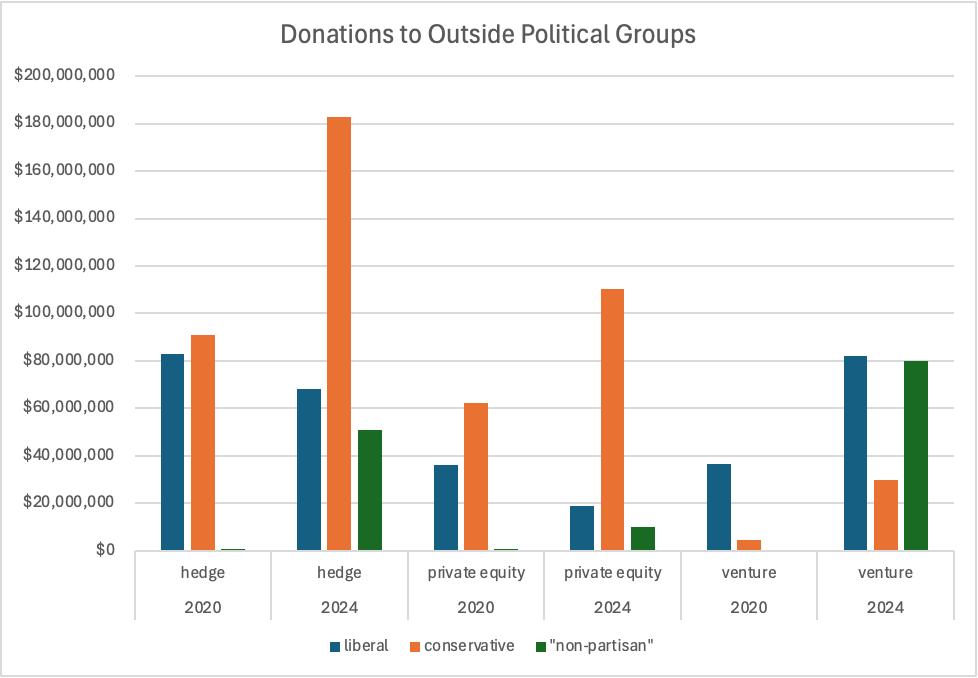
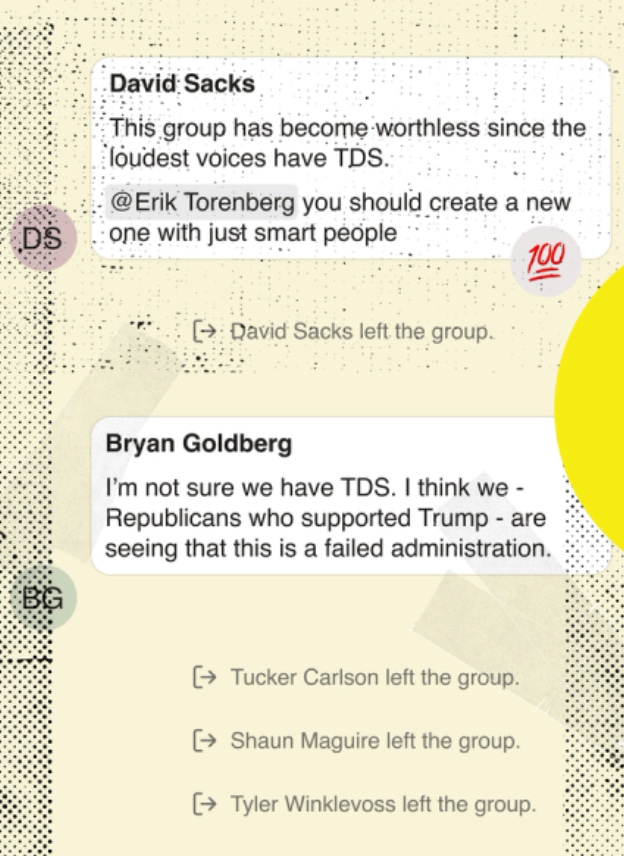
Consistent with this shift, media accounts have presented evidence that key Wall Street and Big Tech billionaires did more than open their wallets. One interesting example is Venture capitalist Marc Andreesen’s organization of Signal chats with a couple hundred finance, tech, and far right intellectual elites. The chats have provided some artifacts of these elites discussing if and why they should help return Trump to power. Closer to my prior research, Andreesen, private equity billionaire Marc Rowan, and their friends have both claimed credit as architects of the Trump’s authoritarian strategy towards universities. And Trump’s anti university strategist Christopher Rufo takes credit for helping Andreesen move some big tech elites to the right through the Chatham House chats. Here is a screen shot of one of those group chats.
Wall Street, tech billionaires, and their minions from the Elon Musk cinematic universe likewise were more than ready to bring their autocratic business model to DOGE and appointments in the Trump administration.
So, we have some initial evidence of a pretty hard pro Trump turn from 2020 to 2024. And we have some initial evidence that it was proactively authoritarian, at least among some of these folks.
So, I’ll turn now to the question of why this turn happened and whether it was related to increasing oligarchy. My first step here is to ask, what is oligarchy and who are oligarchs? This is not a rhetorical question for me at this point. I am still trying to figure this out.
From my brief crash course in the literature so far, I have at least learned thatoligarchy derives from Greek for rule of the few. The second thing, I think you can get from Michels, is that to have oligarchy, youhave to have oligarchs with personal power.
There are some further common characteristics of capitalist oligarchs:
• Operate across the blurred boundaries of finance and industry (Veblen 1904, Brandeis 1914, Mills 1956)
• Extract wealth by controlling multiple enterprises or individual monopolies over entire industries (Kahn 2016; Tomaskovic-Devey 2018). One way to think about this is that corporations work for oligarchs, not the other way around. So even some CEOs of top corporations do not really fit neatly in the oligarchy category.
• Employ elite social ties and politics to defend their position (Winters 2011, Wright & Sengupta, 2013, Eaton 2022, Eaton & Gibadullina 2025)
Who, then are oligarchs past and present? Here are some examples:
· Industries: Finance / energy, utilities / media
· Old: JP Morgan / Rockefeller / Hearst, Murdoch
· New: Private equity (LBO and Venture) / Big Tech
I focus on private equity and Big tech based on some intuitions from a couple of prior and ongoing projects. One of those projects is a paper with Albina Gibadullina, Adam Goldstein, and Marie-Lou Laprise. A working paper version of this should make its way into the world in the next few months.
This project offers some insights for how we might understand private equity, venture capital, hedge funds, and big tech as playing complementary roles in building and maintaining monopolies as sources of their oligarch’s wealth and power.
Venture capitalist Peter Thiel has summed this up nicely as an oligarchic strategy, saying, “Competition is for losers.”
In our paper, we focus particularly on leveraged buyout funds. But we show that venture capital and private equity play complementary roles in building monopolies under private ownership, including tech monopolies. Venture startups rarely go public. Instead they get bought by private equity leveraged buyout funds. As part of the monopoly building process, we show that buyout funds also rarely take companies public through IPOs anymore. Instead, they keep companies under private ownership longer, and they exit investments by selling their portfolio companies to publicly traded competitors. This can contribute to the consolidation of market power among a dwindling number of increasingly large publicly traded corporations.
This framework updates the outdated paradigm for understanding venture capital and private equity’s role in corporate ownership and control. The old paradigm paints venture capital creating challengers to incumbents and private equity as buying and breaking up publicly traded conglomerates. In fact, for a long time, they’ve done the opposite, including around big tech.
You can see that in these tech sector varieties of the venture capital, LBO, and public M&A life cycle. In one example, Andreesen Horowitz invested in the BlueCoat cyber security firm which was later acquired in LBO buyouts by Thoma Bravo among others. BlueCoat grew through the acquisition of several competitors. Ultimately it was sold to publicly traded Symantec which was merged into Broadcom, helping create one of the ten corporations with a trillion dollars in market capitalization.
Private equity similarly grew Mindbody through rollup acquisitions of 11 different competitors. Athena health and Signify involved fewer mergers, but both started under venture and then were acquired by LBO funds. New Mountain Capital exited Signify by selling it to publicly traded CVS. I like these last three examples because they all involved using tech and platform business models in previously brick and mortar sectors.
Zooming out, this life cycle helps us understand how venture and private equity oligarchs extract their wealth from both the privately held and publicly held portions of the economy.
Through this rise of private equity, private equity and VC ownership grew from negligible in the 1990s to somewhere between 10 and 20% of all corporate net worth today. In the privately held third of the economy under corporate ownership (as opposed to public firms and unincorporated businesses) private equity and VC ownership has grown to somewhere closer between 35% and 55% of all business net worth.
Importantly for our monopoly story, buyout funds have increasingly engaged in what are known as add-on buyouts. Add-on buyouts are buyouts where a buyout fund buys a company to merge it with another portfolio firm that it already owns. This is the central transaction that private equity uses to build monopolies.
Finally, private equity has helped build publicly listed monopolies that are increasingly owned by a small number of Wall Street asset managers like BlackRock. This includes Big Tech monopolies by which “software is eating the world.” Private equity does this by selling their portfolio firms to publicly listed monopolies in merger and acquisition sales. I mentioned earlier that private equity rarely exits its investments through IPOs anymore. That might preserve a competitor to publicly traded incumbents. Instead, private equity exits through merger and acquisition sales to publicly traded competitors.
Through these new roles, private equity has contributed to declines in the number of publicly traded corporations even as publicly traded ownership has held steady as a share of all business net worth.
In sum, private equity, giant Wall Street asset managers, venture capital, and Big Tech firms have together built the monopolies that have furnished the new wealth of oligarchs. Gabriel Zucman and Emmanuel Saez have shown that the wealth of the 19 richest Americans exceeds that of their counterparts in the top 0.00001% during the Gilded Age (e.g. Carnegie, Morgan, Rockefeller, Vanderbilt) when measured as the share of national income. Zucman has said these new multi-billionaires engage more in politics than their predecessors because they have more to lose.
My impression from tracking statements by venture capital, private equity, and big tech – as well as investigative reporting like that on Chatham House – is that these guys turned to Trump in anger at the populist turn in some Democratic economic policy, particularly on anti-trust. But private equity and tech have also voiced other criticisms of Democrats, including complaints about Crypto regulation, AI regulation, and social policies they criticize as “woke.” And the most vocal oligarchs, are also the most extremely online – subject to the same mind warp that social media has inflicted on everyone.
So one next step for research, to paraphrase Robert Merton, is to confirm that this phenomenon is actually happening before I go further in trying to explain it. For this, I’ve been thinking about expanding the very coarse analysis of Open Secrets data I showed you, to track how patterns in political donations changed over time in my Wall Street sectors of interest and Big Tech, in comparison to changes in other sectors. I want to get more of a handle on timing and shifting political contexts going back to Citizens United, Dodd Frank, finance’s reaction to Dodd Frank, and Trump’s initial election.
And I’m interested in how these finance and big tech donation patterns may have moved in relationship to other industries with historically oligarchic structures and high market concentration. This could involve linking data or analytic coding on monopoly adjacent industries to Open Secrets data on donations by its 100 industry and 400 subindustry categories. I have said little about hedge funds today. And that’s in part because I see the hedge fund industry as less directly tied to monopoly projects in finance and big tech. So similar hedge fund movement could actually contradict some of the thesis I’ve toyed with today.
The last thing I’ve been considering is linking OpenSecrets data to the Forbes 400 billionaire lists to create a sort of analytic sample to examine political giving behavior.
If, in fact, there’s been an oligarchic turn to Trump’s democratic backsliding as a strategy for wealth defense, you might imagine the implications for what sort of political-economic shifts would be needed to restore democracy after a Trump presidency. Now that the autocratic playbook has been opened, it is hard to imagine oligarchs accepting a return to democratic norms that might threaten their wealth and power. If that is the case, it seems that a return to democracy may be difficult without curtailing oligarchical wealth and its application towards our politics.
References
· Andreessen, Marc. “Why Software Is Eating the World.” Andreessen Horowitz, August 20, 2011. https://a16z.com/why-software-is-eating-the-world/
· Andreessen Horowitz. 2024. “Crisis in Higher Ed & Why Universities Still Matter with Marc & Ben.” The Ben & Marc Show, January 14, 2024.
· Andreessen Horowitz. 2024. “Fixing Higher Education & New Startup Opportunities with Marc and Ben.” The Ben & Marc Show, February 8, 2024.
· Brandeis, Louis D. 1914. Other People’s Money—and How the Bankers Use It. New York: Frederick A. Stokes.
· Eaton, Charlie, and Albina Gibadullina. 2025. Elite embeddedness: the rise of financiers on university boards as parallel social organizations. Socio-Economic Review 23 (3): 1057–1089.
· Fridman, Lex. 2025. “#458 – Marc Andreessen: Trump, Power, Tech, AI, Immigration & Future of America.”Lex Fridman Podcast, January 26, 2025.
· Hoang, Kimberly Kay. 2022. Spiderweb Capitalism: How Global Elites Exploit Frontier Markets. Princeton, NJ: Princeton University Press.
· Khan, Lina M. 2017. Amazon’s Antitrust Paradox. Yale Law Journal 126 (3): 710–805.
· Levitsky, Steven, and Daniel Ziblatt. 2018. How Democracies Die. New York: Crown.
· Mallaby, Sebastian. 2011. More Money Than God: Hedge Funds and the Making of a New Elite. New York: Penguin Press.
· Mills, C. Wright. 1956. The Power Elite. New York: Oxford University Press.
· Neely, Megan Tobias. 2022. Hedged Out: Inequality and Insecurity on Wall Street. Oakland: University of California Press.
· Smith, Ben. 2025. “The Group Chats That Changed America.” Semafor, April 27, 2025.
· Thiel, Peter. 2014. Competition Is for Losers. Wall Street Journal, September 12, 2014.
· Veblen, Thorstein. 1904. The Theory of Business Enterprise. New York: Charles Scribner’s Sons.
· Winters, Jeffrey A. 2011. Oligarchy. New York: Cambridge University Press.
· Zucman, Gabriel. 2026. “Standing up to Trump’s Imperial Blackmail on Greenland.” Gabriel Zucman (English), January 18, 2026.

Great name. All the best.
https://brutusmac.substack.com/p/a-raging-king-unafraid-to-die?utm_campaign=post-expanded-share&utm_medium=post%20viewer
I like the new title! And enjoyed the post - that text chain screen shot!